
4. Alesund, Norway

This is our second stop on our Norway adventure and although I am not in the habit of comparing places, Alesund is every bit as beautiful as Stavanger. There is an eeny-weeny problem, though. This cruise is not on the general cruise schedule and the tourist information centres are not aware of our arrival. This makes it difficult for us to take advantage of the types of tours not related to the ship. We have booked an afternoon tour and have some limited time this morning to explore the town surrounding the pier.
There is an air of confusion around the pier this morning and since we have some time restraints, which do not allow for waiting around to see whether the local tour operators are going to arrive, we take a taxi to our first stop.
We could have done what many on our tour have done and walked the 418 stone steps up the steep Mt Aksla, but that would take me all day. After negotiating a price for a cab, we jump in and watch the town slowly fall beneath us as the taxi climbs higher and higher up a steep and narrow road. Although the road is open all year round, according to our driver, most people do not drive up here. At the top of the mountain, we get out of the cab and take a few shots. There are a few more steps to take to reach the pinnacle, which Tom does. I walk around the viewing platform slightly below, getting a wonderful panorama of the town and beyond. Standing on top of a mountain provides the long range view that cannot be appreciated otherwise. All the time I am up on the hill, heads pop up from the walking track. There are people on our ship who have taken up the challenge and have taken the walk from the park to the top of the mountain. Almost filled with guilt, and I do say almost, but not really, we jump into our cab and make the road journey back to the pier.

Alesund is unique in that after a fire that swept through the town in 1904, destroying almost every building and rendering 10,000 people homeless, it was rebuilt in stone. Using an Art Nouveau style, the town has whimsical turrets and towers, floral embellishments, distinctive motifs, and colourful facades. With some time up our sleeves, we wander through the streets and marvel at the architecture and the idea that someone could actually plan to create a town with nooks and crannies and cobbled streets. I can almost imagine trolls and kings and princesses with long golden hair. This is indeed like being inside the pages of a real fairy tale.

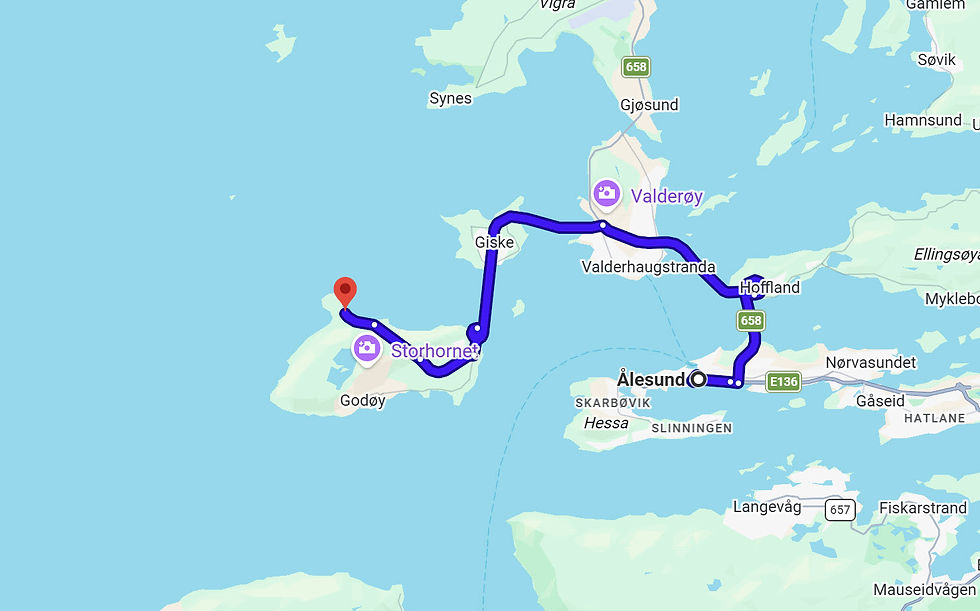
This afternoon's tour is of the saga islands of Godoya and Giske. It is alleged the the Viking Rollo was born in this region. Rollo would become a Viking menace to Europe and in particular, to France and would become the first Duke of Normandy after the French government handed that slice of France to the Vikings in return for a promise to no longer invade the country. Although Rollo was only mentioned in passing during the tour, it was interesting to see the area from where he was born.
Alesund and its surrounding islands are connected by a series of undersea tunnels and as we enter the first one, are reminded that perhaps the technology that allows the Norwegians to tunnel well below the surface of the water is far more superior that those we have beneath the Yarra. The first tunnel is three lanes. In the direction we are going, away from Alesund and downhill, it is one single lane. Towards the end of the tunnel, and as we travel on an incline, the road switches to two lanes on our side. It is a most ingenious system. Emerging from this first tunnel, we immediately enter another one that is over four kilometres in length then we cross a bridge that is like a steep hump connecting two islands before arriving on the island of Giske. We will return here later as we will start our tour on the far island of Godoya. There is another tunnel to drive through. Since the populations are quite low here, this tunnel is a single vehicle lane and a bicycle lane. Unlike single-lane tunnels we have encountered elsewhere, we do not have to wait at the end for the line of traffic to pass through. Instead, this tunnel has a right of way for those leaving the island. If the road is clear and you are entering into the island, you may enter and drive slowly along the lane. When a vehicle approaches from the island, it slows to allow the car driving into the island to get to a parking bay, where it remains until the road is clear again and when it can continue. It is an ingenious system and works very well for the courteous Norwegian road users. I cannot imagine Australians abiding by these rules.
We emerge out of the tunnel and into the pretty, green and lush island. The beaches are sandy and the flat land at the base of towering rocks is green. This area has milder temperatures due to being in the path of a gulf stream and is quite fertile. Crops are not grown, but it can be used for sheep grazing in the summer. We reach a place called Alnes, where we stop so we can visit the lighthouse. Tom climbs to the top whilst I stay below to take his photo.
Aboard the bus again, we drive to the tunnel and as we have right of way now, the driver's speed is adjusted when he sees oncoming traffic. Again, I wonder at the way in which Norway can keep its communities together by ensuring they have the ability to leave their islands all through the year. Ferries can only work efficiently during the summer so the tunnels provide a lifeline for all those who live out here.
We arrive on the island of Giske and stop at a little old white church. We are invited inside and asked to take a pew. Before long, my backside is feeling quite hot until I realise the central heating is in the floor below the pews and it is blasting hot air. A docent stands at a modern pulpit. The old carved one is just near her as she shares the history of this church. Most importantly, it is the oldest standing church in Norway and is the only one built entirely of Norwegian and Italian marble, which has been covered with chalk and plaster. The dominant feature of the church is the colourful altarpiece that is attributed to master carver Jakob Sørensen Giskeødegaard. The carved pulpit is attributed to the same carver. It is amazing how much history can be held in such a tiny place and I am glad we have done this tour today.
We return to our ship and await our departure, which has been delayed for some reason. I peek over the balcony to see whether the delay is caused by stragglers, but see that the gangplank has been drawn. A little while later, we hear the gears grinding and we start moving slowly from the pier. This is, like Stavanger yesterday, some of the prettiest places we have ever visited and we are looking forward to our next stop of Tromso in the north of Norway.
...and then comes the announcement from the Captain. Why do they only speak when they have bad news to impart?
Our itinerary has been abandoned.
We will not be travelling to Tromso due to a huge storm in the north. We must turn southward and a new itinerary has been drawn up.
Tomorrow's sea day has been replaced with a stop.
Come back tomorrow and I will tell you what happens next.
Comments